Table of Contents
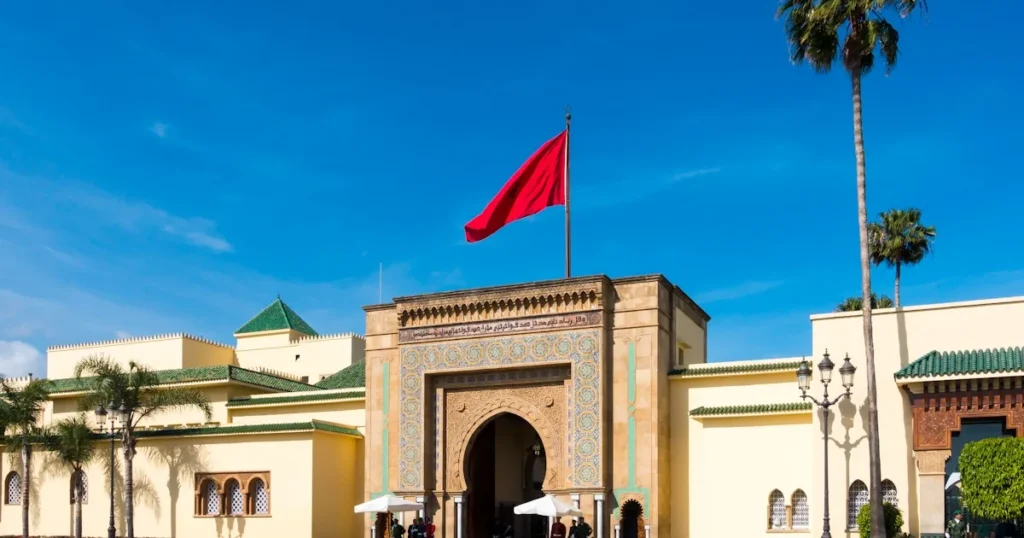
🇲🇦 KEY FACTS: Morocco Flag at a Glance
| Flag Adopted | November 17, 1915 (Royal Decree by Sultan Moulay Youssef) |
| Colors | Red (background) · Green (interlaced pentagram star) |
| Symbolism | Red = Alawite Dynasty, bravery & blood of ancestors; Green Star = Seal of Solomon, 5 Pillars of Islam, health & life |
| Legal Basis | Article 4 of the Moroccan Constitution |
| Flag Ratio | 2:3 (width to length) |
| Hex Colors | Red: #C1272D · Green: #006233 |
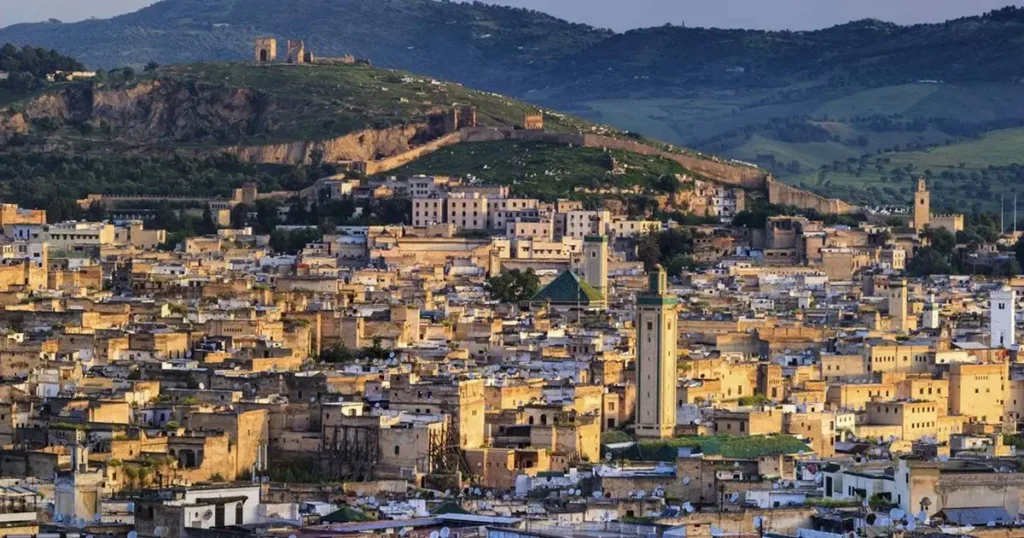
You’ve seen it waving proudly over the medinas of Marrakech, snapping in the Atlantic breeze above Casablanca’s corniche, and draped across the doorways of ancient riads in Fes. But how much do you really know about the Morocco flag? Beyond its striking red and green palette lies more than a thousand years of dynasty, faith, and geopolitical strategy. Whether you’re planning your first journey to the Kingdom or are simply a passionate traveler curious about the stories behind the symbols, this guide unravels every thread.
From the plain white banners of the Idrisid founders to the 1915 Moroccan decree that gave the flag its iconic green star, the journey of this national symbol is as rich and layered as the country itself. Let’s explore.
The Deep Symbolism of the Morocco Flag (Beyond Red and Green)
Most travel guides will tell you the Moroccan flag is red with a green star. That’s technically accurate — but it barely scratches the surface. Every element of this flag is a deliberate, historically charged choice.
The Red Field: Blood, Dynasty, and Divine Lineage
The commanding red background of the Morocco flag is not simply an aesthetic choice. It is the color of the Alawite Dynasty, the royal house that has ruled Morocco since the 17th century and continues to do so today under King Mohammed VI.
The Alawites trace their lineage directly to the Prophet Muhammad through his grandson Hassan ibn Ali. Across the Islamic world, red has long been associated with the descendants of the Prophet, known as sharifs or shurafa. When you look at that deep crimson field, you’re looking at a declaration of sacred ancestry, a visual statement of Morocco’s place within the broader tapestry of Islamic civilization.
Beyond dynastic heritage, red carries the weight of bravery, strength, and the blood of ancestors who defended the land across centuries of conquest, resistance, and empire-building. It is a color that speaks to Moroccan identity at its most foundational.
The Green Pentagram (Khatim Suleiman): Suleiman’s Seal Explained
At the heart of the red field sits a green interlaced pentagram, a five-pointed star known in Arabic as Khatim Suleiman or the Seal of Solomon. This is one of the most significant details in understanding Morocco flag meaning.
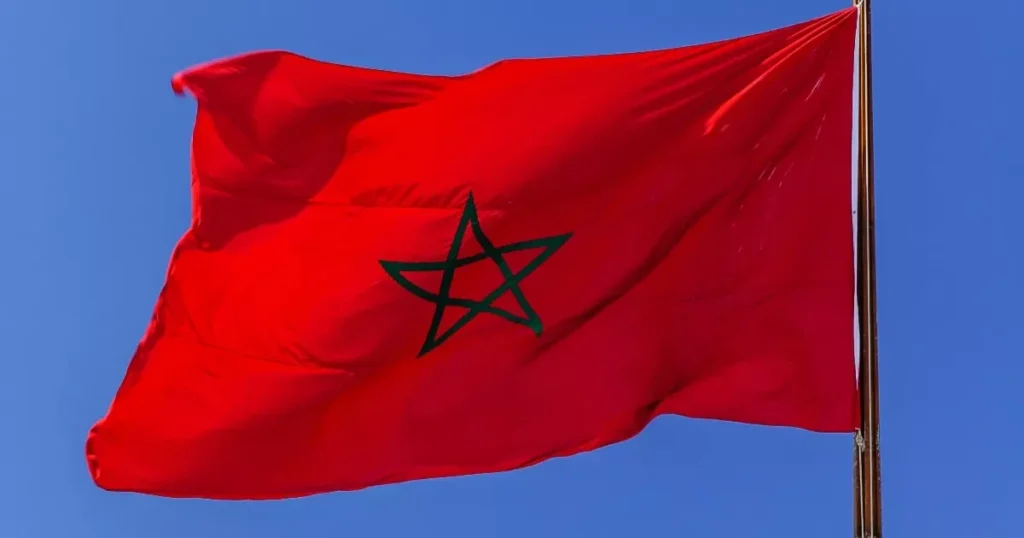
Here’s a nuance that most travel content misses entirely: the star was not always five-pointed. Before the 1915 decree, the emblem associated with Moroccan Islamic tradition was often the six-pointed Star of David (hexagram), which was also called the Seal of Solomon and was historically used across both Jewish and Islamic cultures as a symbol of divine wisdom. The shift to the five-pointed star in 1915 was a deliberate modernization, one that anchored the symbol more firmly in a specifically Islamic cultural context.
The five points of the green star on the Morocco flag are widely understood to represent the Five Pillars of Islam: Shahada (declaration of faith), Salah (prayer), Zakat (almsgiving), Sawm (fasting during Ramadan), and Hajj (pilgrimage to Mecca). The star’s green color, universally regarded as the color of Islam and the Prophet’s banner, adds another layer of spiritual resonance. It also represents health, hope, and the fertile land of Morocco itself.
The interlaced design, where the lines of the star weave over and under each other, represents the unity and interconnectedness of these five pillars, the inseparability of faith, life, and governance in Moroccan society.
What does the green star on the Morocco flag represent?
The green pentagram (Khatim Suleiman / Seal of Solomon) on the Moroccan flag represents the Five Pillars of Islam and the connection between God and the nation. The color green symbolizes the Prophet Muhammad’s legacy, health, and life. Its interlaced design reflects the unity of faith and governance in Moroccan civilization.
Historical Evolution of the Morocco Flag: A Journey Through Time
Morocco is one of the oldest continuously governed nations in the world. Its flag has evolved across dynasties, empires, and protectorates, each iteration reflecting the power and vision of its era.
| Period | Era | Flag Description |
|---|---|---|
| 788–974 AD | Idrisid Dynasty | Plain white flag — a symbol of Islamic purity and the founding of Fes |
| 1147–1269 | Almohad Empire | Red and white “chessboard” pattern — a distinctive battle standard |
| 1269–1465 | Marinid Dynasty | Solid red field — the color of the ruling dynasty established |
| 1666–1915 | Alawite Dynasty (pre-decree) | Plain red flag used as maritime standard; no star or symbol |
| 1915 | French Protectorate Era | Green pentagram added by Sultan Moulay Youssef to distinguish Moroccan vessels from other red flags at sea |
| 1956–Present | Independent Morocco | Flag codified in the Constitution after independence; Article 4 enshrines it as the national flag |
Why Was the Star Added in 1915? (The Story Behind the 1915 Moroccan Decree)
The most historically significant moment in the Morocco flag’s evolution came in 1915, during the French Protectorate (1912–1956). Under the protectorate, Morocco was technically still governed by Sultan Moulay Youssef, though France controlled most administrative functions.
At sea, Moroccan vessels flew a plain red maritime flag — identical to several other flags used across the region. This created genuine navigational and diplomatic confusion. On November 17, 1915, Sultan Moulay Youssef issued the royal decree that officially added the green interlaced pentagram to the center of the flag. The star served a dual purpose: it was a practical identification marker for Moroccan ships, and it was a powerful assertion of Moroccan Islamic identity during a period of colonial occupation. Even under French rule, the Sultan was declaring — through the flag — that Morocco’s civilization, faith, and sovereignty endured.
This act of symbol-making was quietly radical. The green pentagram on a sea of red became Morocco’s way of saying: we are still here, and we remember who we are.
When was the Morocco flag created?
The current Morocco flag in its modern form was officially adopted on November 17, 1915, by royal decree of Sultan Moulay Youssef. The plain red background dates back to the Alawite Dynasty in the 17th century, while the earliest Moroccan flags date to the Idrisid period (788 AD). The flag was constitutionally enshrined after independence in 1956.
Technical Specifications: The Morocco Flag by the Numbers
For designers, journalists, flag enthusiasts, or anyone creating content featuring the Moroccan flag — accuracy matters. Here are the precise technical specifications that most travel websites never provide.
Official Color Codes
| Color | HEX | RGB | CMYK | Pantone (approx.) |
|---|---|---|---|---|
| Red (Background) | #C1272D | 193, 39, 45 | 0, 80, 77, 24 | PMS 186 C |
| Green (Star) | #006233 | 0, 98, 51 | 100, 0, 48, 62 | PMS 349 C |
Flag Dimensions and Construction
- Ratio: 2:3 (height to width)
- Star position: Centered on the flag field
- Star diameter: Approximately 1/3 of the flag’s height
- Star type: Interlaced pentagram (the lines weave over and under each other)
- Star orientation: One point directed upward
- Star outline: The star lines are roughly 1/50th of the flag’s height in thickness
Why is the Moroccan flag red and green?
The Morocco flag is red and green because each color carries deep historical and religious meaning. Red represents the Alawite Dynasty’s descent from the Prophet Muhammad, and symbolizes the bravery and sacrifice of Moroccan ancestors. Green — the color of Islam and the Prophet’s banner — represents the Seal of Solomon (pentagram star), the Five Pillars of Islam, and hope for the nation’s future.
Cultural Etiquette & Usage: How the Morocco Flag Is Honored
For travelers visiting Morocco, understanding how the flag is treated is a matter of cultural respect — and it will deepen your appreciation of Moroccan national identity when you witness these traditions firsthand.
Fête du Trône (Throne Day) — The Flag’s Biggest Moment
The most spectacular display of Moroccan national pride occurs each year on July 30th, Fête du Trône (Throne Day), commemorating the accession of King Mohammed VI to the throne in 1999. On this day, the Morocco flag appears on virtually every building, vehicle, and public space across the kingdom. Streets are draped in red and green bunting, government buildings display enormous flags, and celebrations erupt in city squares from Agadir to Oujda.
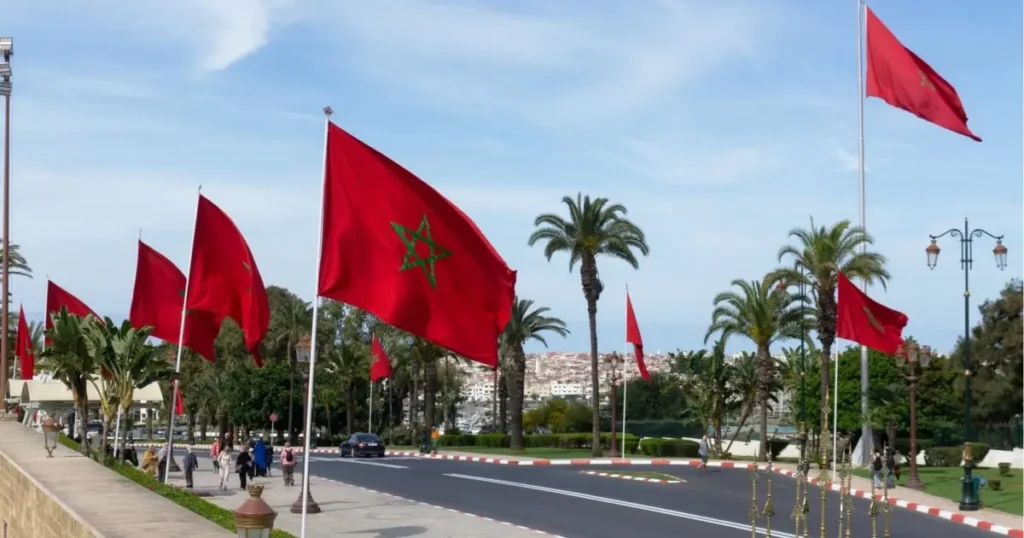
If you happen to be visiting Morocco around this date, we highly recommend it; witnessing Throne Day is one of the most immersive cultural experiences available to any traveler. The national pride is palpable and deeply moving.
Flying the Flag: Protocol and Royal Standard
The Moroccan flag is subject to official protocol, particularly when flown alongside the Royal Standard (the personal flag of the King). Key customs include:
- The national flag always flies to the right of the Royal Standard when displayed together
- Government buildings display the flag every day, not just on national holidays
- During official state ceremonies and visits, the flag is flown at full mast unless the nation is in mourning
- Citizens are expected to treat the flag with reverence, disrespecting or desecrating it is considered a criminal offense under Moroccan law
- During international sporting events, the Morocco flag is a ubiquitous symbol of national pride, especially following the Moroccan national football team’s historic 2022 FIFA World Cup run, which brought the flag into living rooms across the globe
The Flag in Daily Life
Beyond official ceremonies, the Morocco flag is deeply woven into everyday life. You’ll spot it on car antennae in the medinas, painted as murals in the New Towns, embroidered on traditional djellabas during national holidays, and proudly displayed by Moroccan communities around the world. It is not merely a state symbol; it is a lived expression of Moroccan identity.
As a visitor, you’re welcome to purchase small Moroccan flags from souks and markets as a souvenir. Doing so is seen as a respectful gesture of appreciation for the country and its culture.
Frequently Asked Questions About the Morocco Flag
❓ What does the green star on the Morocco flag represent? The green pentagram (Khatim Suleiman, or Seal of Solomon) represents the Five Pillars of Islam — Shahada, Salah, Zakat, Sawm, and Hajj. Its green color symbolizes the Prophet Muhammad’s legacy, life, and hope. The interlaced design reflects the unity of faith and national identity in Moroccan civilization.
❓ Why is the Moroccan flag red and green? Red represents Morocco’s Alawite Dynasty — whose rulers claim descent from the Prophet Muhammad — and symbolizes the bravery and blood of ancestors who defended the nation. Green is the color of Islam and represents the Seal of Solomon star, the Five Pillars of Islam, and the promise of health and prosperity.
❓ When was the Morocco flag created? The modern Morocco flag was officially adopted on November 17, 1915, when Sultan Moulay Youssef issued a royal decree adding the green pentagram to the plain red flag. The red background dates to the Alawite Dynasty (17th century), while Morocco’s oldest flags date to the Idrisid founding in 788 AD. The flag gained constitutional status after independence in 1956 under Article 4.
❓ Was the Moroccan flag always red with a star? No. Morocco’s flag has changed significantly across dynasties. The Idrisids used a plain white flag; the Almohads used a red and white chessboard pattern; the Marinids established the solid red field. The star was only added in 1915 to distinguish Moroccan maritime vessels during the French Protectorate era.
See the Morocco Flag Come Alive: Plan Your Journey
Understanding the Morocco flag is one thing. Standing beneath it in the Djemaa el-Fna of Marrakech as the call to prayer echoes across the rooftops, that’s something else entirely. Every element of this flag tells you something about the country you’re about to explore: the red of ancient dynasties, the green star of living faith, the centuries of history compressed into a single elegant design.
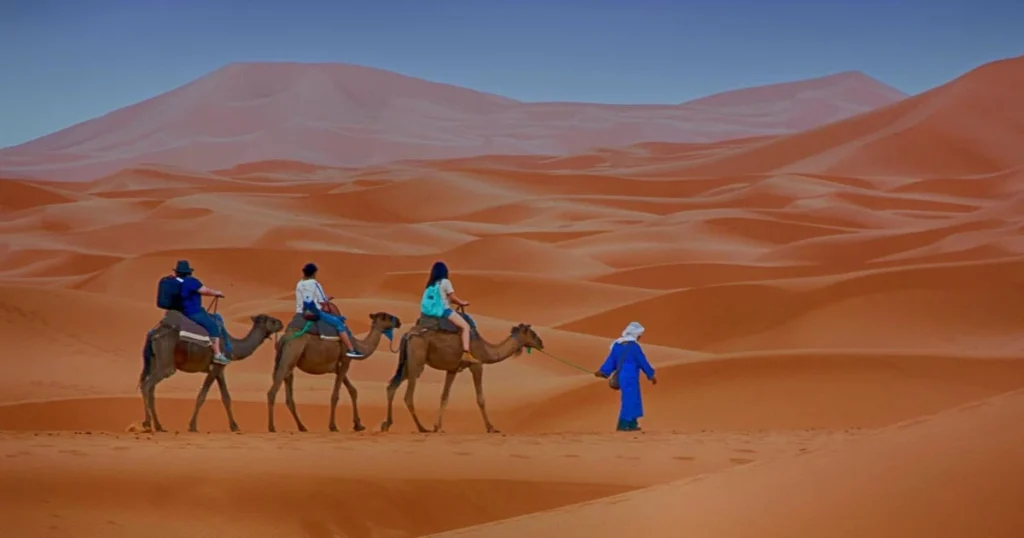
At Desert Merzouga Tours, we believe the best way to understand Morocco is to immerse yourself in it. Our expert local guides don’t just show you the landmarks; they bring the history, culture, and symbolism to life in ways that no guidebook ever could. Whether you’re exploring the imperial cities of Marrakech, Fes, and Meknes, enjoying camel trekking in the golden dunes,, or sleeping under a canvas of stars in the Sahara Desert near Merzouga, our bespoke itineraries are crafted to turn curious travelers into lifelong lovers of Morocco.
Ready to see the red and green waving over the most beautiful landscapes in North Africa? Our team is ready to design your perfect Moroccan adventure.